
Research
Virevium One
A locally run, supervised agent that plays a game the way a person does: by looking at the screen and pressing keys. It is the first Virevium project and it is in active development.
The question
Can an agent learn from its own experience to play alongside people as a useful teammate, and can each step toward that be shown with evidence someone else can check? Virevium One builds that up one capability at a time: reaching a place, handling a threat, travelling at speed.
How it works today
Eyes
It reads the game window as pixels. Position and heading come from the game's own on-screen debug text; enemy health bars are found by colour and shape.
Body
It sends ordinary keyboard and mouse input. It does not read the game's memory, inject code or edit game files.
Skills
Local control routines for navigation, self-defence and mounted travel, each built and tested one at a time.
Direction
Between runs, an AI assistant chooses goals and waypoints with the founder supervising. Nothing in the cloud acts inside the real-time loop.
Record
Every decision tick is logged with its inputs, and frames are saved, so a run can be examined afterwards.
Where it runs
The proving ground is Veloren, an open-source game, in a private single-player world on one PC. Virevium is not affiliated with the Veloren project.
Demonstrated so far
Each of these is documented in the progress journal as a development note, with its method and evidence.
| Date | Skill | What was measured |
|---|---|---|
| 2026-11-10 | Walk to a point | 3 of 3 round trips on flat ground and 3 of 3 on steps, each ending within 3 units of the target |
| 2026-11-10 | Follow a road | 298 units each way, 40 s out and 36 s back, one stall cleared by a jump |
| 2026-11-10 | Defend itself | Detected an attack and defeated the attacker in two live engagements |
| 2026-11-10 | Mount and dismount | 10 of 10 cycles confirmed by the agent's own check |
| 2026-11-10 | Ride to a map destination | Reached a destination about 500 units away on horseback, with one operator-assisted detour |
From the recorded runs
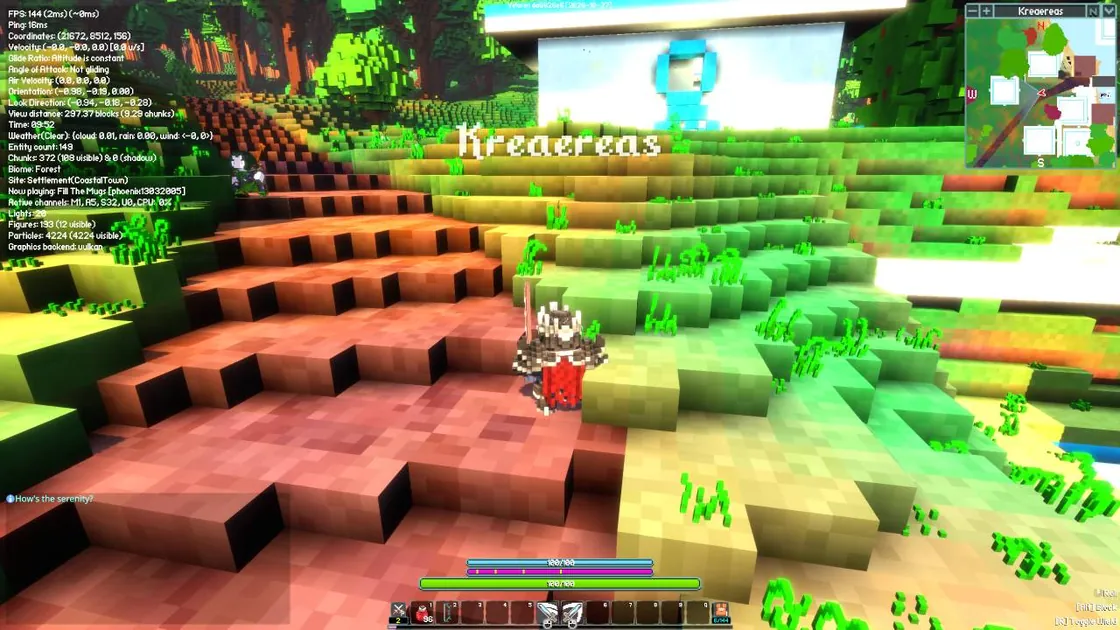
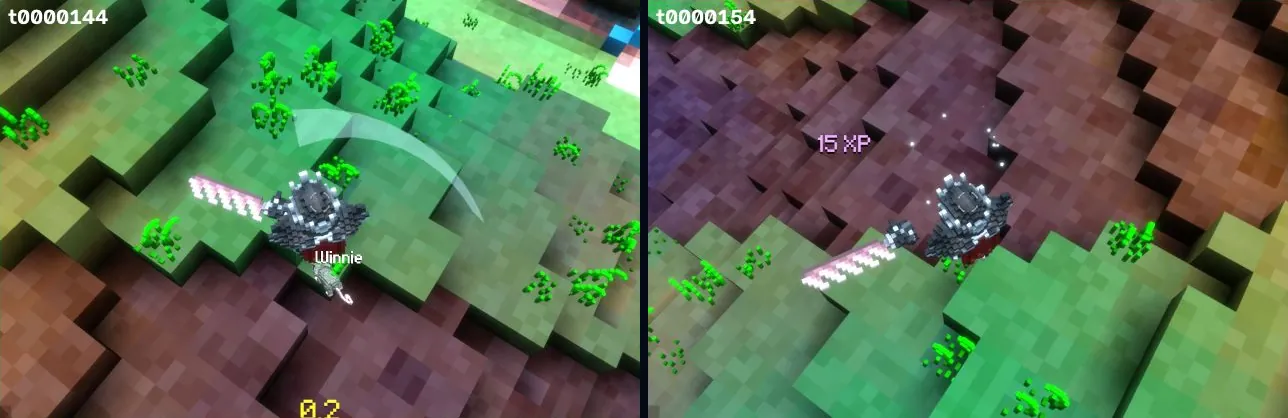
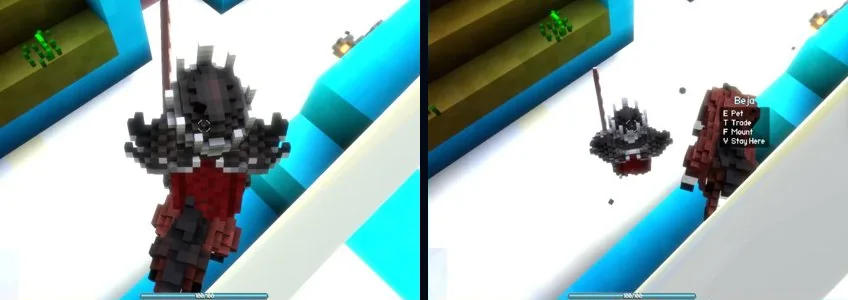
Frames are from the project's own recorded runs in Veloren, an open-source game.
In active development
- Adaptive navigation
- Recovering from unfamiliar obstacles without operator input.
- Sustained engagements
- Healing, retreat and tougher opponents.
- Learning from experience
- A standard episode format for the logs, then the first learned components trained and tested on them.
- Cooperative play
- Working alongside human players in approved multiplayer environments, under supervision.
- Scored trials
- Moving each capability from development note to a result scored against rules fixed beforehand.